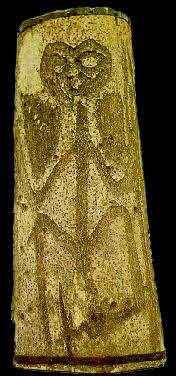
 photo by splunge
 photo by TheophileEscargot
 photo by Kronos_to_Earth
 photo by ethylene
Comment Feed:
♦ RSS
At least two of the characters are mentioned in Mitchell's first book, Ghostwritten (1999). Luisa Rey, the protagonist of the third story, 'Half-Lives', is mentioned in a radio show dedication in the 'Night Train' segment of Ghostwritten, while Timothy Cavendish, from the fourth story, 'The Ghastly Ordeal', appears as a minor character in 'London'. In addition, the phrase cloud atlas is used as a descriptive flourish by the narrator Eiji Miyake in Mitchell's second novel, number9dream.
Adam Ewing finds (in a rather contrived / stiched on section) the wooden masks from the zachry section. This is the "story" which is passed from the last section to the first section. I'd say that the reincarnation theme is cyclical. I guess his Russian Doll format also tries to reflect this.
posted by seanyboy 08 January | 17:41
are we being warned about what our future could hold if we inevitably continue with cloning?
Funny, i never thought that it was reincarnation. I did notice the recurring birthmark etc, but it seemed tobe more like connections or resonances, or even like a hole of the needle thats sewing the sections together. I think reincarnation is too strong a word for this.
Why is Zachry the protagonist in Meronym's era? Is he any less important than Meronym? I think he's trying to show the reincarnation thing is a red herring; it's about everyone's impact on everyone else. And amro, you've encapsulated that nicely with the idea of the author's impact. Thanks.
posted by Eideteker 08 January | 17:41
The actual past is brittle, ever dimming + ever more problematic to access + reconstruct: in contrast, the virtual past is malleable, ever-brightening + ever more difficult to circumvent/expose as fraudulent.
Times are you say a person's b'liefs ain't true, they think you're sayin' their lifes ain't true an' their truth ain't true.
Middle-age is flown, but it is attitude, not years, that condems one to the ranks of the Undead, or else proffers salvation. In the domain of the young there dwells many an Undead soul. They rush about so, their inner putrefraction is concealed for a few decades, that is all.
A life spent shaping a world I want Jackson to inherit, not one I fear Jackson shall inherit, this strikes me as a life worth the living.
Except that the records passed on are corrupted and mediated and not the actual events, too--something I think is important, and about fictions in general. Luisa's story is a novel, Cavendish is a movie, etc. Only with Adam and Frobisher was it actually their words, no?